
Does Summer School Help Your University Application?


Key takeaways:
When applying to university, one question comes up again and again: does summer school help your application?
For many students, summer schools seem like a natural way to stand out. They offer the chance to explore a subject in more depth, experience a different style of learning, and demonstrate academic interest beyond the classroom. But when it comes to university admissions, their value is often misunderstood.
Universities are not simply looking for more experiences. They are looking for how you think—how you engage with ideas, how you reflect on what you learn, and how you develop your perspective over time.
This is where a summer school can make a difference.
Not because of the name or the certificate, but because of what the experience allows you to do: explore ideas more deeply, question assumptions, and engage with your subject in a more independent and thoughtful way.
Does Summer School Help University Applications? (Quick Answer)
Summer schools can support your university application by helping you develop independent thinking, explore subjects in greater depth, and demonstrate genuine academic interest beyond the classroom. Through discussion, guided learning, and exposure to new perspectives, you begin to engage with your subject in a more analytical and reflective way.
What makes this experience valuable is how it shapes your thinking. Universities are interested in how you approach ideas—how you question them, explore them, and build on them over time. A summer school gives you the opportunity to do exactly that.
When you reflect on what you have learned—whether by challenging assumptions, deepening your understanding, or discovering new areas of interest—you begin to show the kind of intellectual curiosity and independence that universities value.
What Universities Are Really Looking For
Strong grades matter. But they are only part of the picture.
Universities are looking for students who can think independently, engage with complex ideas, and communicate their reasoning with clarity. At a higher level of study, learning is not just about absorbing information—it’s about questioning it, analysing it, and forming your own perspective.
This is why many universities value supercurricular exploration—how you choose to engage with your subject beyond the classroom. This might involve reading more widely, exploring different viewpoints, attending lectures, or reflecting more critically on ideas.
What makes the difference is not simply doing more, but thinking more deeply about what you explore.
For example, two students might read the same book or attend the same course. One focuses on what they learned. The other reflects on the arguments, considers alternative perspectives, and thinks about how it has shaped their understanding.
It is this deeper engagement that universities value.
A well-chosen summer school can support this kind of development. It provides the time, structure, and academic guidance to explore ideas in depth, challenge assumptions, and refine your thinking through discussion.
Not as a credential—but as a catalyst for deeper intellectual engagement.
Do Universities Care About Summer Schools?
Yes—but in a more meaningful way than many expect.
Universities recognise summer schools as part of a wider academic journey. What matters most, however, is not the experience itself, but what it reveals about how you think and engage with your subject.
Admissions tutors are interested in how you use the opportunity. They look for:
- What you explored in depth
- How your thinking developed
- What questions or ideas stayed with you afterwards
In other words, they are looking for intellectual engagement.
For example, two students might attend the same summer school. One describes the topics covered. The other reflects on how a particular discussion challenged their assumptions or changed how they approach a subject.
It is this second approach that stands out.
This is because university study is built on independent thought. Tutors are looking for students who are ready to question ideas, analyse arguments, and contribute to academic discussion.
A summer school can be a powerful way to demonstrate this. Through discussion, exploration, and reflection, it gives you the opportunity to develop a more thoughtful and independent approach to learning.
Is Summer School Worth It? A Comparison
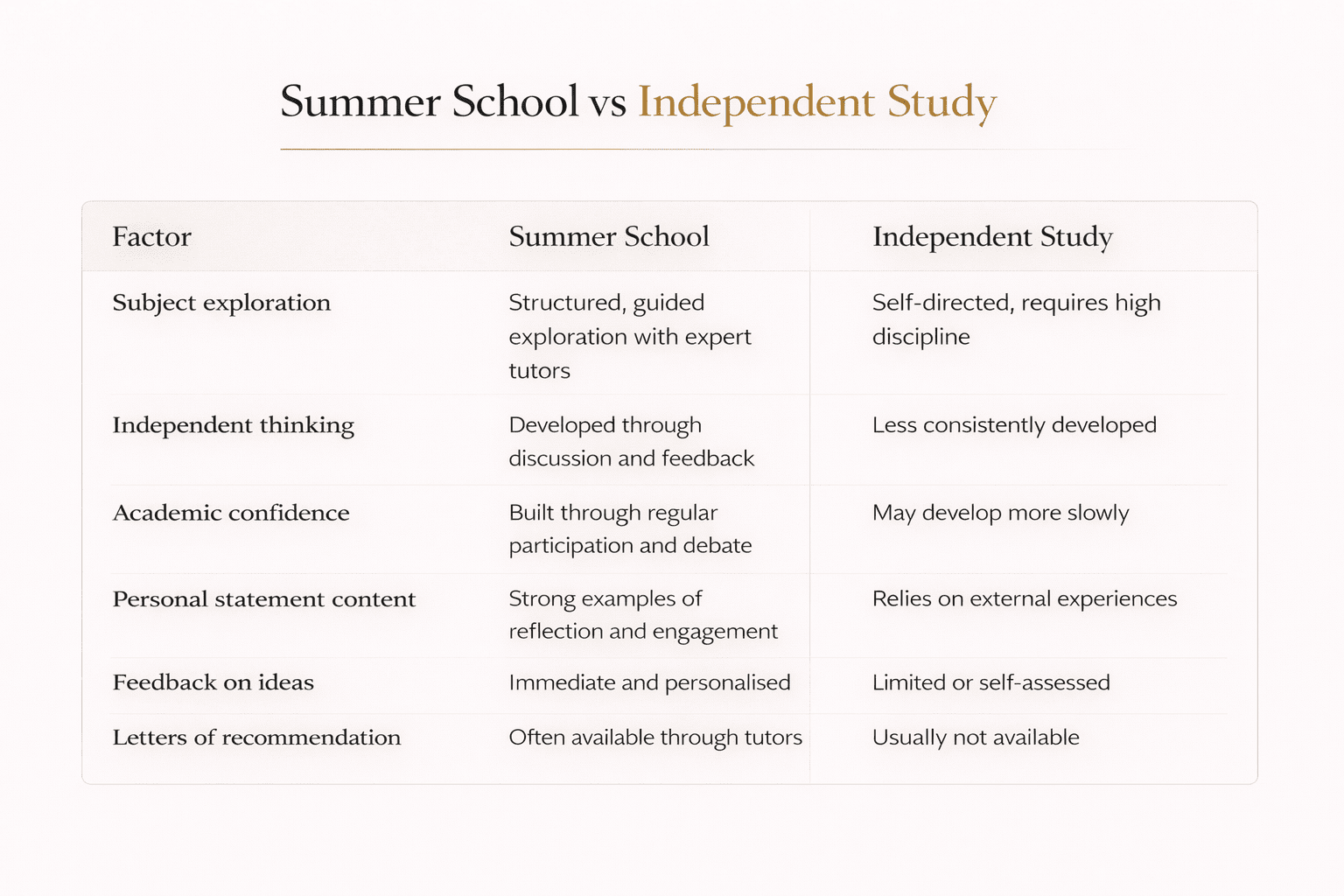
This comparison highlights an important point: it’s not about whether you attend a summer school, but how effectively you engage with opportunities to develop your thinking.
It’s Not Just About the Certificate
A common misconception is that a summer school acts as a qualification.
In reality, its value goes beyond a certificate.
Universities do not assess summer schools as formal credentials. Instead, they look at how you engage with the experience and what it reveals about your approach to learning.
What matters is how you think, not simply what you have done.
A strong application demonstrates:
- Depth of understanding
- Reflection on ideas
- Intellectual curiosity
- A willingness to question and explore
For example, attending a course on law is far more powerful when you can explain how a specific case, discussion, or concept challenged your assumptions or shaped your perspective.
This is where a summer school becomes valuable.
It gives you the space to explore ideas in depth, engage with new perspectives, and develop a more thoughtful, independent approach to your subject—something universities genuinely value.
How Summer Schools Can Strengthen Your Application
A meaningful summer school experience supports your application in subtle, but powerful ways. Not by adding something to list, but by changing how you approach your subject—how you think, question, and engage with ideas over time.
This shift is what universities are looking for.
Independent Thinking
One of the most important changes is how you begin to think for yourself. In a discussion-led environment, you are not simply absorbing information—you are expected to engage with it. You question assumptions, evaluate different viewpoints, and begin forming your own conclusions. Over time, this develops a more analytical and independent approach to learning that aligns closely with university expectations.
Deeper Subject Exploration
Summer schools give you the space to go beyond the constraints of a school syllabus. Rather than covering content quickly, you explore ideas in greater depth—often from multiple perspectives. This allows you to move from understanding a topic to actively engaging with it, developing a clearer sense of what interests you and why. You can browse subjects through our course search to see how this works in practice.
Clear Communication
As your thinking develops, so does your ability to express it. Whether through discussion, written work, or presentations, you learn how to structure your ideas clearly and respond thoughtfully to challenge. This is not just about speaking with confidence—it is about communicating complex ideas with precision, which is essential for both applications and academic study.
Confidence in Your Ideas
Perhaps the most noticeable change is confidence. As you regularly test and refine your thinking in discussion, you become more comfortable contributing, defending your perspective, and engaging with more complex questions. This confidence is not surface-level—it comes from a deeper understanding of your subject and your ability to navigate it independently.
Letters of Recommendation: A Meaningful Addition
Some summer schools offer more than the experience itself. At 91论坛, students may receive a personalised letter of recommendation from their tutor.
This is not a generic reference or standardised summary. It is based on how you think, how you engage with ideas, and how you contribute within an academic setting.
Because you learn in small groups, tutors are able to understand your approach in detail. They see how you develop your ideas over time, how you respond to challenge, and how you engage in discussion. This means your recommendation is grounded in real academic interaction, rather than limited observation.
You can learn more about the academic team on our meet our tutors page.
For universities, this kind of insight can be valuable. It adds context to your application by highlighting qualities that are not always visible through grades alone—such as intellectual curiosity, clarity of thought, and engagement with complex ideas.
Like any part of your application, its strength reflects your involvement. The more actively you engage, the more meaningful the outcome.
What Makes a Summer School Valuable for University Applications?
Not all summer schools offer the same experience—and not all contribute equally to your development.
If your goal is to support your university application, the structure and teaching approach matter far more than the name alone. What makes a difference is whether the environment encourages you to think independently, engage with ideas in depth, and reflect on your learning in a meaningful way.
Stronger programmes tend to prioritise:
- Small group learning, where your ideas shape the discussion
- Discussion and debate, rather than passive lectures
- Independent preparation, allowing you to form your own perspective
- Personalised feedback, helping you refine how you think and communicate
These elements work together to create a more active and intellectually engaging experience. Rather than simply covering content, you are encouraged to question ideas, test your reasoning, and develop a clearer understanding of your subject over time.
This kind of environment is what allows a summer school to genuinely support your application. It helps you move beyond surface-level knowledge and develop the confidence and independence that universities value.
You can explore how this approach is applied in practice on our why choose 91论坛 page.
How to Use Summer School in Your Personal Statement
The value of a summer school comes through in how you write about it.
Universities are not looking for a list of experiences. They are looking for insight into how you think, what interests you, and how you engage with ideas. A summer school becomes valuable when you use it to demonstrate this.
Instead of simply stating that you attended a course, focus on what the experience revealed about your academic thinking.
For example, you might reflect on:
- How your perspective on a topic changed
- A specific idea or argument that challenged your assumptions
- A discussion that led you to question or explore something further
- How the experience shaped your academic interests
The most effective personal statements move beyond description and into reflection.
Rather than saying what you did, focus on:
- What you thought
- What you questioned
- What you now want to explore further
For instance, instead of writing that you studied economics, you might explain how a debate on market regulation changed how you understand the balance between theory and real-world application.
This level of reflection shows universities that you are not just participating in learning—you are actively engaging with it.
And that is what makes an application stand out.
Is Summer School Worth It for University Preparation?
A summer school can be a valuable part of your university preparation—particularly when it gives you the opportunity to engage more deeply with your subject.
Universities are not looking for a single experience that defines your application. Instead, they are interested in how you develop your thinking over time—how you explore ideas, reflect on them, and build your own perspective.
A well-structured summer school can support this by helping you:
- Deepen your understanding of your subject beyond the school curriculum
- Develop a clearer academic voice through discussion and reflection
- Build confidence in how you express and defend your ideas
What makes the difference is not just attending, but how you engage with the experience. When you take an active role—questioning ideas, exploring different viewpoints, and reflecting on what you learn—it becomes a meaningful part of your academic development.
In this way, a summer school is not a shortcut, but a step forward. It helps you become a more thoughtful, independent learner—something that naturally strengthens your application.
Experience This Approach in Practice
Understanding how a summer school supports your application is one thing. Experiencing it is another.
At 91论坛, learning is built around discussion, exploration, and independent thought. You study in small groups with expert tutors who guide conversation, challenge your ideas, and help you explore your subject in greater depth.
Rather than following a fixed syllabus, sessions are shaped around how you think and what interests you. This creates space to question ideas, develop your perspective, and engage more actively with your learning.
Over time, this approach helps you build confidence in your thinking and express your ideas more clearly—both of which are valuable when preparing for university.
If you would like to see how this works in practice, you can explore available courses or learn more about why students choose 91论坛.
A More Meaningful Way to Prepare
At its best, a summer school supports far more than your university application.
It changes how you approach learning.
As you begin to question ideas, explore subjects in depth, and develop confidence in your thinking, your application becomes stronger as a natural result. Not because of the experience itself, but because of how it shapes your perspective and how you engage with your subject over time.
This is what universities recognise—and what stays with you beyond the application process.
A strong application is not built on a single experience, but on how you choose to engage with opportunities to learn, reflect, and grow.
If you are considering your next step, you can explore course fees and dates or apply for your place when you feel ready.
Final Thoughts
So, do summer schools help university applications?
Yes—but not in the way many expect.
It is not about where you go. It is about how you think.
A strong application reflects curiosity, independence, and clarity of thought. A well-chosen summer school can help you develop all three—not by adding something to your application, but by shaping how you engage with your subject and how you express your ideas.
Over time, this is what makes the difference. Not a single experience, but the way you learn from it and build on it.
And that is what universities are really looking for.
Frequently Asked Questions
Yes—summer schools can play a valuable role in strengthening your university application. They help you explore your subject in greater depth, develop independent thinking, and demonstrate genuine academic interest. When you reflect on what you’ve learned, this can make your application more thoughtful and compelling.
Universities do value summer schools, particularly when they show how you engage with your subject beyond the classroom. A strong summer school experience highlights your curiosity, motivation, and ability to think independently—all qualities admissions tutors look for.
A summer school can be a highly worthwhile part of your preparation. It gives you the opportunity to build confidence, explore ideas in depth, and develop a more independent approach to learning—helping you feel more prepared for university-level study.
A summer school can strengthen your personal statement by giving you meaningful experiences to reflect on. By writing about how your thinking developed, what ideas challenged you, and what you want to explore further, you can present a more engaging and authentic application.
Attending a summer school allows you to study a subject you enjoy in greater depth, engage with new perspectives, and learn in a more interactive environment. It also helps you build confidence, improve communication, and develop the independent thinking that universities value.
About the author
Rhys Mackenzie is responsible for creating and maintaining educational content at 91论坛, helping students and families access clear, accurate information about studying in Oxford. With several years of experience in digital content and student-focused resources, Rhys specialises in presenting academic programmes in a way that reflects the quality and integrity of the Oxford learning experience. Learn more about Rhys here.
Summary
Summer schools can strengthen your university application by helping you explore your subject in depth, develop independent thinking, and build confidence. What matters most is how the experience shapes your ideas and approach to learning.