
What Is the Oxford Tutorial System? A Complete Guide to How It Works

Key takeaways:
The Oxford tutorial system is one of the most distinctive and influential teaching methods in the world. For centuries, it has shaped how students at the University of Oxford learn—not through passive lectures, but through active discussion, independent thinking, and close academic guidance.
At its core, the tutorial system is built around small, focused conversations between students and expert tutors. These sessions are designed to challenge ideas, deepen understanding, and develop the ability to think critically and express arguments with clarity.
This approach stands in contrast to more traditional models of education. Rather than following a fixed structure or absorbing information at pace, students are encouraged to explore ideas in depth, question assumptions, and take ownership of their learning.
So what does this actually look like in practice? And why does it continue to influence modern teaching methods around the world?
In this guide, you’ll explore how the Oxford tutorial system works, what happens inside a typical tutorial, and how this approach helps you develop confidence in your thinking—not just knowledge of a subject.
What Is the Oxford Tutorial System?
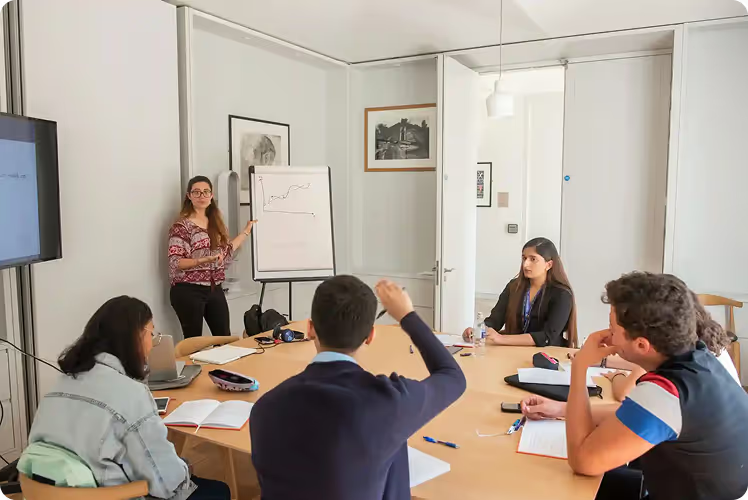
The Oxford tutorial system is a teaching method based on small-group academic discussions between students and expert tutors. Typically involving one to three students, these sessions—known as tutorials—form the core of the learning experience at the University of Oxford.
Rather than relying primarily on lectures, the tutorial system is built around active participation. You are expected to prepare work in advance—often in the form of an essay, analysis, or problem set—and use this as the foundation for discussion.
This creates a very different learning dynamic.
Instead of passively receiving information, you are actively engaging with ideas from the outset. Tutorials are not about being given answers. They are about exploring questions, testing your reasoning, and developing your ability to think critically.
During each session, your ideas are examined in detail. Your tutor may challenge your assumptions, ask you to justify your conclusions, or introduce alternative perspectives that push your thinking further. This process helps you move beyond surface-level understanding towards deeper intellectual engagement.
At its core, the tutorial system is designed to help you think independently. Over time, you learn how to analyse arguments, evaluate evidence, and communicate your ideas with clarity and confidence.
This philosophy—learning how to think rather than what to think—continues to shape modern teaching approaches, including those outlined in our teaching methodology.
How Does the Oxford Tutorial System Work?
Before each tutorial, you are set a piece of independent work. This might involve writing an essay, analysing a text, reviewing case studies, or working through a set of problems, depending on your subject.
This stage is not simply about completing a task—it is where much of the learning begins.
You are expected to engage actively with the material, rather than passively reading it. This often means exploring different viewpoints, identifying key arguments, and deciding what you think about them. In many cases, there is no single correct answer, so the focus shifts to how you develop and support your ideas.
You may find yourself asking questions such as: Which argument is most convincing? What evidence supports it? Where might it be limited?
This process encourages you to think independently before entering the tutorial, ensuring that the discussion is built around your perspective rather than someone else’s.
This emphasis on independent preparation is central to discussion-led learning environments, including those you can explore across our course options.
Discussion: Exploring Ideas in Depth
The tutorial itself is a focused academic conversation built around your work.
You may begin by summarising your argument or explaining how you approached a particular question. From there, the tutor guides the discussion—asking questions that challenge your reasoning, test your assumptions, and encourage you to think more deeply.
For example, you might be asked to justify your conclusions, compare your ideas with alternative perspectives, or reconsider a point from a different angle. This is not about being right or wrong—it is about refining your thinking.
Because tutorials are small, the discussion is highly interactive. You are expected to respond, adapt your ideas, and engage actively throughout the session.
This dynamic exchange allows ideas to be explored in far greater depth than in a traditional classroom setting.
Reflection: Improving Through Feedback
At the end of each tutorial, you receive immediate and detailed feedback on your work.
This feedback is highly specific. Your tutor focuses on your argument, your reasoning, and how clearly you have expressed your ideas. Rather than general comments, you receive targeted guidance on what is working well and where you can improve.
Importantly, this feedback is part of an ongoing process. Each tutorial builds on the last, allowing you to apply what you have learned and continue developing over time.
This continuous cycle—prepare, discuss, refine—is what makes the tutorial system so effective. It ensures that learning is active, personalised, and constantly evolving.
What Happens in an Oxford Tutorial?
A typical Oxford tutorial is structured around your ideas, but the direction of each session is shaped by how the discussion develops.
You usually begin with work you have prepared in advance—often an essay, set of notes, or problem set. In some cases, you may be asked to summarise your argument or explain how you approached a particular question. This provides a starting point for the conversation.
From there, the tutorial becomes a focused academic discussion.
Your tutor will ask questions that challenge your reasoning, test your assumptions, and encourage you to think more deeply about the topic. You might be asked to justify your conclusions, compare your ideas with alternative viewpoints, or reconsider a point from a different perspective.
For example, in a literature tutorial, you might explore how your interpretation of a text differs from another critical viewpoint, and what evidence supports each argument. In a science-based subject, you could be asked to explain your reasoning step by step, ensuring you understand both the method and the outcome.
Because tutorials are so small, you are expected to engage throughout. There is little room to remain passive. Instead, you respond to questions, refine your ideas in real time, and develop your thinking as the discussion progresses.
There is no fixed script. Some tutorials may stay closely focused on your original work, while others may branch into wider themes or related concepts. This flexibility allows ideas to be explored in greater depth.
By the end of the session, you will not only have a clearer understanding of the topic, but also a better sense of how to improve your thinking in future work.
Why Is the Oxford Tutorial System So Effective?
The Oxford tutorial system is widely regarded as one of the most effective teaching methods because it fundamentally changes how you engage with learning.
Rather than placing you in a passive role, it positions you at the centre of the academic process. You are not simply receiving information—you are actively working with it, questioning it, and developing your own perspective.
Active participation
From the moment a tutorial begins, you are expected to contribute. Whether presenting your ideas or responding to questions, you are fully involved in the discussion. This level of participation helps you engage more deeply with the subject and retain what you learn more effectively.
Independent thinking
Because tutorials are built around your preparation, you arrive with your own ideas already formed. The discussion then becomes a space to test and refine those ideas. Over time, this develops your ability to think critically, evaluate arguments, and form your own conclusions with confidence.
Immediate, personalised feedback
In a tutorial, feedback is not delayed or generalised. Your tutor responds directly to your work, focusing on your reasoning, your structure, and your understanding. This allows you to see exactly how to improve and apply that insight straight away.
Depth of understanding
Unlike traditional classroom settings, where content is often covered quickly, tutorials prioritise depth over breadth. You spend time exploring ideas in detail—examining different perspectives, challenging assumptions, and refining your thinking. This leads to a more nuanced and lasting understanding of your subject.
Together, these elements create a learning environment that is both intellectually demanding and highly effective. You are not just learning more—you are learning better.
Oxford Tutorials vs Traditional Classroom Learning
Lectures and tutorials offer very different learning experiences. Understanding this difference helps explain why the tutorial system is so effective.
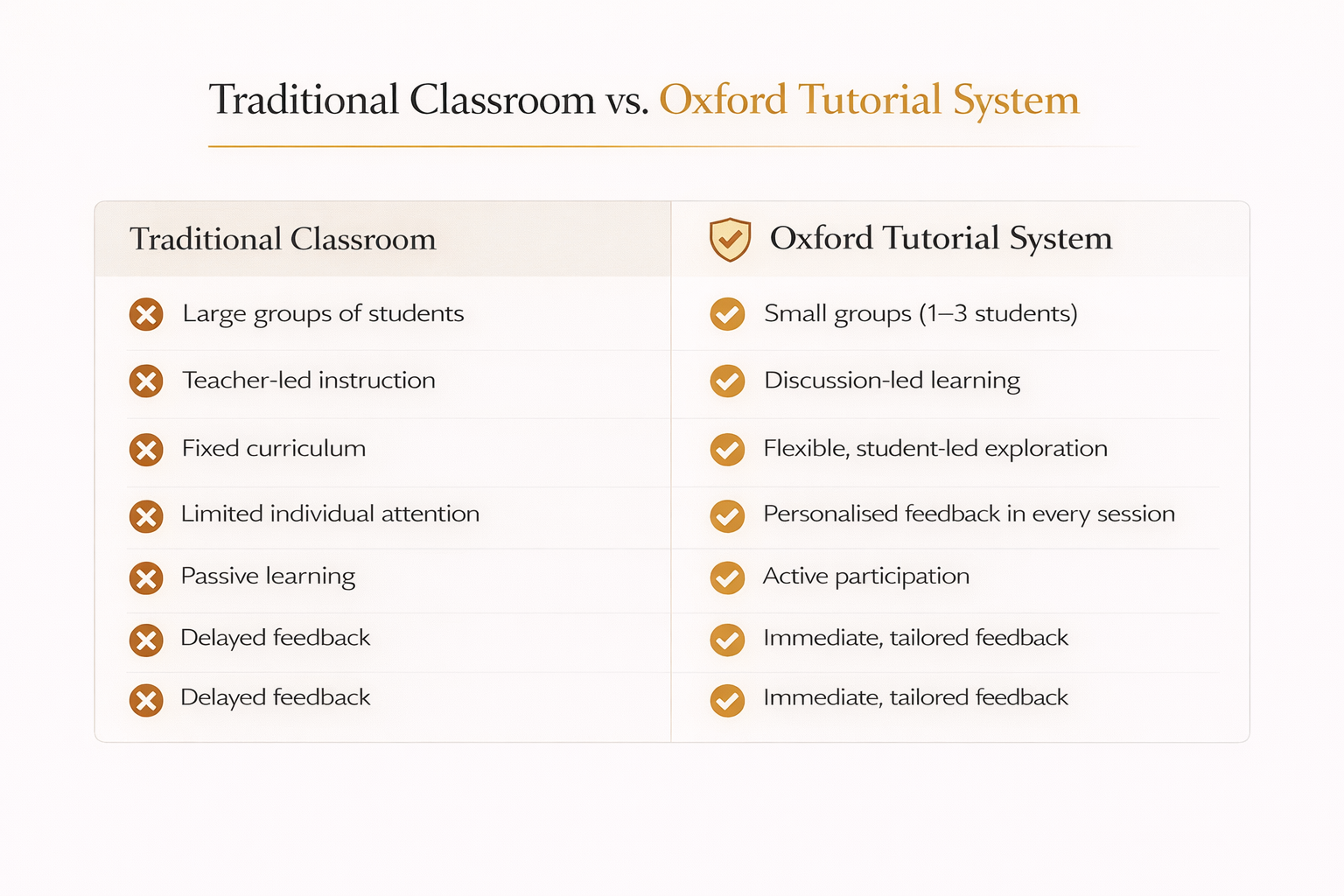
Lectures are useful for introducing ideas. Tutorials are where those ideas are explored, challenged, and understood.
What Skills Do You Develop?
The Oxford tutorial system helps you develop a set of academic and intellectual skills that extend far beyond subject knowledge. These are not taught directly—they are built through repeated practice, discussion, and reflection.
Critical thinking
You learn how to analyse arguments in detail, identify assumptions, and evaluate evidence. Rather than accepting information at face value, you are encouraged to question it—asking why an argument works, where it may be limited, and how it could be strengthened.
Communication
In every tutorial, you are expected to explain your ideas clearly. Whether discussing an essay or working through a problem, you develop the ability to structure your thoughts, express them with precision, and respond thoughtfully to questions or challenges.
Confidence in your ideas
Regularly presenting and defending your thinking builds confidence over time. You become more comfortable contributing to academic discussions and more assured in your ability to engage with complex topics.
Independent learning
Because tutorials are built around your preparation, you learn how to manage your own learning process. This includes researching effectively, forming your own perspective, and taking responsibility for your progress.
Problem-solving
You develop the ability to approach complex questions methodically. By breaking down problems, testing ideas, and refining your reasoning, you learn how to navigate uncertainty and arrive at well-supported conclusions.
Together, these skills shape how you think, not just what you know. They continue to be valuable long after the learning experience itself.
What You Gain from the Tutorial System

This combination of skills supports both academic growth and personal development.
A Personalised Approach to Learning
One of the defining features of the Oxford tutorial system is its flexibility. Unlike traditional classroom models, where every student follows the same structure, tutorials are shaped around the individual.
Your tutor adapts each session based on your interests, your pace, and how your thinking develops over time. If a particular idea sparks your curiosity, there is space to explore it in more depth. If something feels unclear, the discussion can slow down to focus on understanding it properly.
This creates a learning experience that feels both responsive and engaging. You are not working through a fixed path—you are actively shaping the direction of your learning.
Over time, this approach encourages greater independence. You begin to take ownership of your ideas, ask more meaningful questions, and develop a clearer sense of how you think and learn best.
This kind of personalised, discussion-led learning is reflected in how courses are designed at 91论坛. You can explore how this works in practice through our teaching methodology, where sessions are shaped around student input rather than a rigid syllabus.
If you are considering your options, reviewing course fees and dates can also help you understand how different programmes are structured.
The Role of the Tutor
In the Oxford tutorial system, tutors play a very different role from traditional classroom teachers.
Rather than delivering information, they guide how you engage with it. Their focus is not simply on what you learn, but on how you think.
During a tutorial, your tutor will question your assumptions, challenge your reasoning, and introduce perspectives you may not have considered. This is not about testing you—it is about helping you explore ideas more deeply and develop greater clarity in your thinking.
Because tutorials take place in such small groups, tutors can respond directly to your work and your progress. They adapt their approach based on your strengths, the areas you find more challenging, and the direction your ideas are taking.
Over time, this creates a more collaborative learning environment. You are not just being taught—you are actively engaging in a shared academic discussion, where your ideas are taken seriously and developed through dialogue.
This relationship between tutor and student is central to the tutorial system. It allows for a level of personal attention and intellectual challenge that is difficult to achieve in larger classroom settings.
Is the Oxford Tutorial System Challenging?
The Oxford tutorial system is designed to challenge you—but in a way that supports your development rather than overwhelms it.
Unlike more structured classroom environments, you are expected to take an active role in your learning. This means preparing work independently, contributing to discussions, and engaging with feedback in a meaningful way.
At first, this can feel unfamiliar. You may not be used to having your ideas questioned or asked to explain your reasoning in detail. However, this is a central part of the process.
Tutorials are not about getting everything right. They are about exploring ideas, testing your thinking, and learning how to improve. Your tutor guides this process, creating an environment where you can develop confidence while being challenged.
Over time, what initially feels demanding becomes more natural. You begin to approach problems more independently, express your ideas more clearly, and engage more confidently in discussion.
This balance—challenge combined with support—is what makes the tutorial system so effective. It pushes you to grow, while ensuring you are guided at every stage.
If you are considering whether this approach is right for you, you can request more information to explore how this style of learning works in practice.
The History of the Oxford Tutorial System
The Oxford tutorial system has been at the heart of teaching at the University of Oxford for hundreds of years, with its origins dating back to the early development of the collegiate university.
In its earliest form, education at Oxford was built around close relationships between scholars and students. Rather than formal lectures, learning often took place through direct discussion, where students would present their ideas and receive guidance from experienced academics.
Over time, this evolved into the structured tutorial system used today. The core principle remained the same: students learn most effectively when they actively engage with ideas, rather than passively receive information.
By the 19th century, the tutorial had become a defining feature of Oxford education. It was designed to complement lectures by providing a space for deeper exploration—where students could test arguments, challenge assumptions, and refine their thinking in a more personal setting.
Today, the tutorial system continues to play a central role in Oxford’s teaching approach. While education systems around the world have moved towards larger class sizes and standardised curricula, the tutorial remains focused on small-group discussion, personalised feedback, and independent thought.
Its influence now extends far beyond Oxford. Many modern educational programmes have adopted elements of this approach—particularly the emphasis on discussion, critical thinking, and student-led learning.
Can You Experience the Oxford Tutorial System?
While the Oxford tutorial system itself is unique to the University of Oxford, its underlying principles can be experienced in other academic settings.
These principles—small-group learning, discussion-led teaching, and personalised feedback—are designed to help you engage more actively with your subject and develop confidence in your thinking.
Inspired by this approach, some programmes create learning environments where ideas are explored through conversation rather than delivered through lectures. This allows you to take a more active role in your learning, shaping discussions, testing your understanding, and developing your own perspective.
At 91论坛, these principles inform how you learn. You study in small groups with expert tutors who guide discussion, adapt to your interests, and provide tailored feedback on your work.
Rather than following a fixed syllabus, sessions are shaped around your ideas and how your thinking develops over time. This creates space to explore topics in greater depth, ask questions, and engage with different perspectives in a meaningful way.
It is important to be clear: this is not a replication of the Oxford tutorial system. However, it is inspired by the same philosophy—encouraging independent thought, active participation, and deeper academic engagement.
If you would like to understand how this works in practice, you can explore our teaching methodology.
Experience an Oxford-Inspired Way of Learning
Inspired by the Oxford and Cambridge teaching traditions, our approach focuses on discussion, debate, and discovery.
You learn in small groups with expert tutors who guide you through ideas, challenge your thinking, and help you explore subjects in depth. With more time for conversation and tailored feedback, you are able to engage more fully with your subject—developing both confidence and academic ability in a supportive, intellectually stimulating environment.
Rather than following a fixed syllabus, your tutor adapts each session to your interests and pace. This creates space to explore what genuinely interests you, ask more meaningful questions, and develop your own perspective—whether across humanities, sciences, or interdisciplinary subjects available through our course search.
Each lesson is designed not simply to deliver content, but to encourage you to think independently, challenge assumptions, and engage actively with new ideas. Over time, this helps you build the skills and confidence to approach unfamiliar topics with clarity and curiosity.
This approach is inspired by the tutorial system, not a replication of it. But the principles remain the same: learning through discussion, developing independent thought, and building confidence in your ideas.
If you’re ready to take the next step, you can apply for your place when the time feels right.
Final Thoughts
The Oxford tutorial system is more than a method of teaching. It is a way of learning that places you at the centre of the process.
By encouraging you to question ideas, explore different perspectives, and engage actively in discussion, it helps you move beyond simply understanding a subject to thinking more deeply about it.
Over time, this approach builds not only knowledge, but confidence. You develop the ability to analyse arguments, express your ideas clearly, and approach complex problems with greater independence.
These are skills that extend far beyond the classroom. They shape how you think, how you learn, and how you engage with new ideas long after the experience itself.
For many students, this is what makes the tutorial system so powerful—it changes not just what you learn, but how you approach learning altogether.
Frequently Asked Questions
The Oxford tutorial system works through independent preparation followed by small-group discussions with an expert tutor. Students complete work in advance, then use the tutorial to present ideas, answer questions, and refine their thinking. This approach encourages deeper understanding and develops independent thought.
In an Oxford tutorial, you discuss work you have prepared, such as an essay or problem set, with your tutor. The session focuses on questioning your reasoning, exploring different perspectives, and refining your ideas. This creates a highly interactive learning experience built around your thinking.
The Oxford tutorial system is effective because it places you at the centre of the learning process. Through active discussion, personalised feedback, and continuous refinement, you engage more deeply with ideas. This leads to stronger critical thinking and longer-lasting understanding.
Lectures are designed to introduce key concepts, often to larger groups of students. In contrast, the Oxford tutorial system focuses on small-group discussion, where ideas are analysed, challenged, and explored in depth. This makes learning more personalised and intellectually engaging.
The benefits of the Oxford tutorial system include improved critical thinking, clearer communication, and greater confidence in your ideas. By regularly presenting and defending your perspective, you learn to analyse complex topics and develop independent learning skills that extend beyond the classroom.
About the author
Rhys Mackenzie is responsible for creating and maintaining educational content at 91论坛, helping students and families access clear, accurate information about studying in Oxford. With several years of experience in digital content and student-focused resources, Rhys specialises in presenting academic programmes in a way that reflects the quality and integrity of the Oxford learning experience. Learn more about Rhys here.
Summary
The Oxford tutorial system is a discussion-led approach where students actively engage with ideas in small groups, guided by expert tutors. Through independent preparation, in-depth conversation, and personalised feedback, it develops critical thinking, confidence, and a deeper understanding of subjects—focusing on how to think, not just what to learn.